

Small garage storage has a way of spiralling out of control before you even notice it happening. It starts with the car. Then comes the spare tyre that had nowhere else to go. Then the camping gear from 2021 that you absolutely plan to use again. Then the mystery boxes from the last house move. Then the kids' sport equipment, the broken lawnmower, the paint cans, the extension cord collection. Now the car lives in the driveway and you can't even find the torch.
Here's the thing: a standard single-car garage in Australia measures roughly 3.5 metres wide by 6 metres long by 2.4 metres high. That's 21 square metres of floor space. Every centimetre of that floor, every wall surface, and every overhead metre counts. The good news is that small doesn't mean hopeless. Many garage owners are now using free online visualisation tools to map their entire storage layout before purchasing a single bracket, which means fewer wrong-sized shelves and less wasted spend.
This guide gives you a practical, step-by-step approach to reclaiming your garage: vertical shelving, wall storage, overhead systems, a layout plan you can actually follow, and budget tiers so you know exactly where your money goes.
Why small garages become unusable so fast
The floor is not your storage friend
Floor stacking feels logical in the moment. You arrive home with a new purchase, you put it on the floor, done. Six months later, that floor stack has multiplied and you're doing a sideways shuffle every time you walk in. The core principle of small garage storage is non-negotiable: floor space is premium real estate and every solution worth considering moves items off the floor and onto walls, vertical shelving, or the ceiling.
Once you commit to that principle, the entire problem changes shape. Instead of asking "where do I put this?", you start asking "which surface should hold this?", a much easier question to answer, and one that leads to systems that actually stick.
The zoning principle that changes everything
Zoning means dividing your garage into dedicated areas: tools in one zone, sports gear in another, garden equipment in a third, seasonal items stored high, and a recycling or waste area near the door. Even in a single-car garage measuring 3 x 6 metres, you can map three storage zones along the perimeter walls and ceiling while keeping the centre lane clear for the vehicle.
The measurement rule that makes zoning work: allow at least 600 mm between the parked car and any wall-mounted storage. That gap is what separates a functional garage from one where you're constantly climbing over things to open the car door. Mark it on your floor plan before buying anything.
Small garage storage: vertical shelving that saves floor space
Why height beats footprint in a tight garage
Most small Australian garages have between 2.4 and 2.7 metres of usable wall height. A floor-to-ceiling shelving unit uses the same floor footprint as a short unit but delivers three to four times the storage volume. That is one of the best free upgrades available in small garage storage: going taller instead of wider.
For tight spaces, the recommended unit dimensions are typically 900 to 1,200 mm wide, 400 to 600 mm deep, and 1,800 mm high. Narrower depths of 300 to 400 mm suit tight walkways perfectly. Deeper units of 500 to 600 mm work better along a back wall where you have more room to move around the shelving face.
Steel shelving versus flat-pack timber for small garages
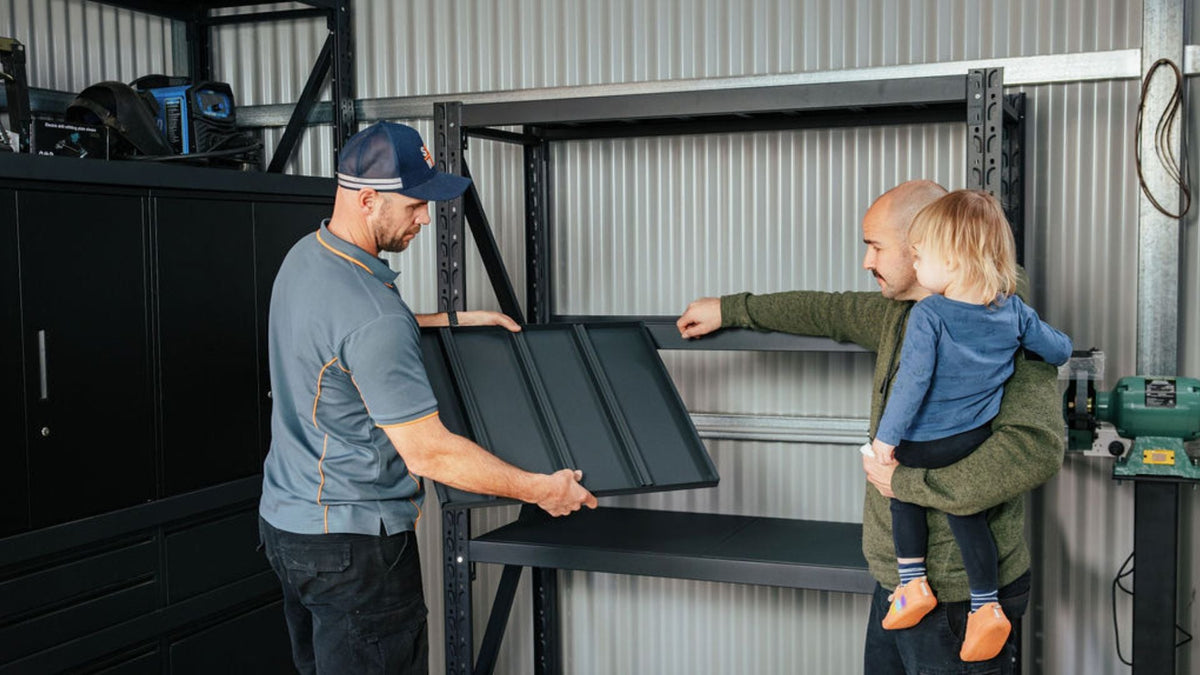
Steel handles higher loads, resists moisture, and holds its shape through the heat and humidity cycles of an Australian garage. Timber is cheaper upfront but warps in outdoor-adjacent environments, and a warped shelf is a useless shelf. For tools, paint cans, and heavy equipment, steel units rated at 200 to 500 kg per shelf are the right call. Light-duty particle board shelves rated at 50 to 100 kg are fine for bins and lightweight household overflow.
Shelving and Storage NE carries steel shelving options suited to both general and heavy-duty garage use, with load capacities across the range to match different storage needs. A well-chosen steel unit holds a serious amount of weight on a footprint no larger than a small bookcase; check their current product listings for pricing and specifications and learn more about Transform Your Garage With Customisable Shelving.
How to stack a small shelving configuration intelligently
The "heavy low, light high" rule is simple and it works: dense items like toolboxes, power equipment, and paint go on lower shelves; seasonal bins, camping gear, and sports equipment sit higher. This keeps the unit stable and means you're not lifting heavy things above your head. Corner shelving and narrow utility shelves are worth considering too, because they fill awkward gaps that would otherwise stay wasted.
Wall storage systems that turn dead space into working zones
Pegboards: the cheapest fast win for hand tools
A standard hardboard pegboard mounted on furring strips is typically one of the most cost-effective storage additions for a small garage, materials are available from most Australian hardware stores, and installation generally takes under 90 minutes for a standard panel. (Prices vary by retailer and panel size; expect a typical range of $40, $120 for materials.) It keeps hand tools visible, accessible, and off the bench. A 1,200 x 900 mm panel is a practical starting size. Mount it at eye level above your workbench and you'll wonder how you managed without it. The real advantage of pegboard in a compact space is flexibility: you can reconfigure hooks and holders as your tool collection changes without putting new holes in the wall. For local hardware and storage product options see Mitre 10's storage & organisation range.
Wall rails and track systems for bulky gear
Horizontal wall rails handle long-handled tools like shovels, rakes, brooms, and extension cords that don't fit neatly on a shelf or pegboard. A basic DIY timber cleat rail takes one to two hours to install and mainly requires lumber and screws. For heavier loads, a metal track system with adjustable hooks is more reliable and worth the extra cost.
Wall rails are particularly valuable in a small garage because they hold items that would otherwise lean against the wall or lie on the floor taking up valuable walking space.
Hooks, bike mounts, and specialist hangers
Bikes, ladders, hoses, and helmets are among the most space-consuming items in a compact garage. Purpose-built hooks and vertical bike mounts lift them off the floor entirely, which can free up a surprisingly large amount of usable space. Position bike mounts high on a side wall to keep the walking lane and car area clear. A bike hanging vertically on a wall mount takes up almost no floor space at all.
Overhead and ceiling storage for the gear you rarely touch
What belongs on a ceiling rack
Ceiling storage is purpose-built for seasonal and infrequently accessed items: holiday decorations, camping equipment, spare tyres, and off-season sports gear. These items are bulky, rarely needed, and perfect candidates for getting completely out of the way. DIY ceiling racks built from 2x4 framing and plywood are affordable but require careful joist anchoring. Commercially rated overhead steel racks offer stated load capacities and genuine peace of mind, compare options when choosing a system.
For small garages where motorised access matters, hoist-style systems rated at around 200 kg are available in Australia and suit tight spaces well; you can retrieve stored items without needing a ladder.
Clearance rules you cannot skip
Overhead racks must clear both the vehicle roof and head height. As a practical guide, allow sufficient clearance above the vehicle roofline, measure carefully and follow the rack manufacturer's installation guidance, as the safe minimum will depend on your specific vehicle height and rack system. Measure from the garage slab to the ceiling, subtract vehicle height, and confirm the rack sits safely above that threshold before purchasing or building. Skipping this step and discovering the rack is 50 mm too low after you've bolted it to the joists is a costly lesson.
Plan your small garage storage layout before you spend anything
Measure first, buy second
Before any purchase, you need four measurements: total wall length on each side, ceiling height, vehicle footprint including mirrors, and door swing clearances for side doors and the roller door. Sketch the floor plan roughly on paper, marking which walls are available for full-height shelving, which are interrupted by windows or doors, and where the electrical panel sits. This ten-minute sketch will save you hours of frustration and potentially hundreds of dollars in returns. For ongoing tips and project ideas, check out The Shed Blog.
Note which walls give you uninterrupted runs of 1,200 mm or more, because those are your best shelving positions. Interrupted walls with windows or pipes are better suited to pegboard panels or hook rails, good examples of garage storage ideas for small spaces that work around existing obstacles rather than fighting them.
How Shelving and Storage NE's free AI garage design tool removes the guesswork
This is where planning gets genuinely useful. Shelving and Storage NE offers a free AI-powered garage design tool that lets you upload a photo of your actual space and receive a personalised shelving layout recommendation with a visual render before committing to any purchase. For small garage storage where every centimetre counts, this removes the guesswork entirely. Instead of buying shelves and hoping they fit the awkward wall behind the hot water system, you see exactly what will work before spending a dollar.
According to Shelving and Storage NE, the tool also auto-builds a shopping cart based on the recommended layout, making the step from planning to purchasing more straightforward. For a compact space combining shelving, wall rails, and an overhead rack, that kind of integrated visualisation helps you avoid the clearance conflicts and wasted spend that come with buying blind.
The storage combination that works for most small Australian garages
A practical three-tier combination by budget
Here's how to approach this based on what you can spend. These are illustrative ranges, expect some variation depending on brand, materials, and supplier:
- Entry level (under $300 AUD): one steel shelving unit running floor to near ceiling, a pegboard for hand tools, and wall hooks for bikes or ladders. This covers the core principle of getting everything off the floor.
- Mid-range ($300, $700 AUD): two to three steel shelving units along the back and side walls, wall rails for long-handled tools, and a basic overhead shelf for seasonal bins.
- Full fit-out ($700, $1,500 AUD): modular steel shelving covering two or three walls, a full pegboard or slatwall panel, overhead ceiling storage, and a compact workbench.
Choosing the right shelving depth for your specific space
Depth choice determines how much walkway you keep. In a single-car garage, 400 mm deep shelving along the side walls typically preserves enough clearance without sacrificing too much storage capacity. Along the back wall, you have more room to go deeper at 500 to 600 mm for bulkier items.
Mixing depths is a smart strategy: deeper on the back wall, shallower on the sides. This maximises storage volume without the space feeling crushed, and it keeps the 600 mm vehicle clearance zone on each side intact.
Stop guessing, start planning
A small garage does not have to stay chaotic. The floor, the walls, and the ceiling are all viable storage surfaces when the right systems are in place. The transformation from unusable chaos to a space that actually functions isn't about spending a lot of money. It's about making smart decisions before you buy anything.
Measure your space. Pick a combination from the three budget tiers above. Use the free AI garage design tool from Shelving and Storage NE to visualise your small garage storage layout before purchasing a single shelf, it's a straightforward way to lock in a plan that works for your specific space. If you're in the Albury-Wodonga region, contact Shelving and Storage NE directly to discuss your options and confirm delivery arrangements, and for seasonal clean-up advice see Spring Garage Clean-Out Tips for Albury-Wodonga Homeowners.
The best small garage storage solution is the one you actually plan before buying, not the one you improvise shelf by shelf over several years. This weekend is a good time to start.
0 comments