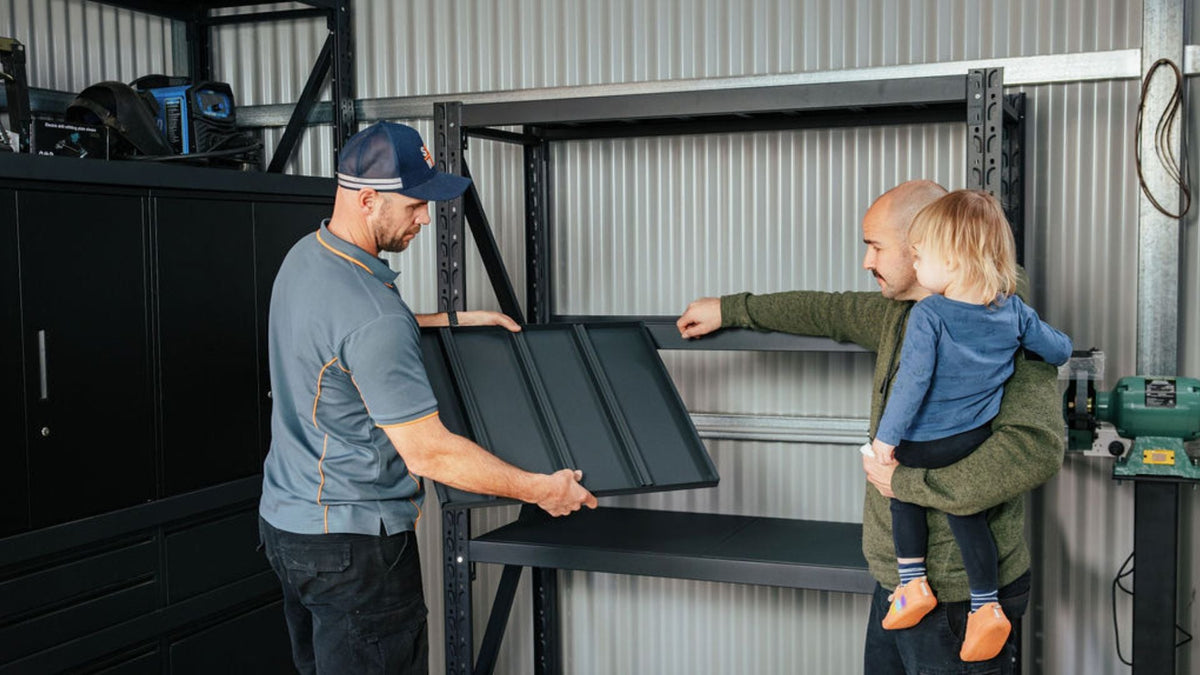


If your garage shelving isn't rated to at least 200kg per shelf, backed by a minimum 5-year warranty, and built with proper bolted fixings — it's not built for an Australian garage. Here's why that matters more than you think.
The Problem Most People Don't See Coming
You bought the shelves. You spent a weekend putting them up. You loaded them with toolboxes, paint tins, gear, boxes of stuff you're definitely going to sort out one day.
And for a while, it was great.
Then six months later, you notice the shelf bowing in the middle. Or the uprights starting to lean. Or — if you're unlucky — you come out one morning to find the whole lot on the floor.
This isn't bad luck. It isn't operator error. It's a predictable outcome of buying shelving that was never designed to do the job you're asking it to do.
The frustrating part? It's completely avoidable — once you know what to look for.
The Load Rating Lie
Every shelf has a load rating — the number printed on the box or listed in the specs. It sounds reassuring. 150kg. 200kg. Sometimes 250kg.
Here's what most people don't know: those numbers are often measured under controlled lab conditions — with weight distributed perfectly across the centre of the shelf, with brand-new fixings, at room temperature.
Your garage isn't a lab.
In a real garage, weight is unevenly distributed. Boxes shift. Heavy items get pushed to one end. Temperatures swing between seasons. The shelf gets loaded, unloaded, and reloaded hundreds of times over its life.
A component designed to carry a static load may fracture and fail if the same — or even a smaller — load is applied repeatedly over time.
— Journal of Civil Engineering and Architecture, Performance of Steel Structures under Fatigue Cyclic Loading
The shelving that holds up under those conditions isn't the cheapest option. It's the one engineered with real-world use in mind — heavier gauge steel, reinforced uprights, and bolted construction that locks every connection point under load. That's exactly what our General Use and Industrial Use shelving is built to do.
Rule of thumb: match your shelving to your actual load. Light storage (boxes, seasonal gear) — 200kg per shelf minimum. Tools, paint, equipment — 300kg. Workshop or trade use — 500kg. Anything rated lower than what you're actually loading is a compromise waiting to happen.
The Steel Gauge Problem
Not all steel is the same. The gauge — or thickness — of the steel used in your shelving has a massive impact on how long it lasts and how much it can hold.
Cheap shelving is made from thin-gauge steel. It feels solid enough when you're putting it together — but under sustained load, over time, thin steel creeps. It bends slowly. It doesn't snap dramatically; it just gradually gives way.
Quality shelving uses thicker gauge steel — particularly in the uprights, which carry the full vertical load of everything on the shelves above. You can't always tell from photos. You often can't tell from the product description.
The easiest shortcut? Check the warranty. A manufacturer who uses quality steel is confident enough to back it with a long warranty. A company offering 12 months is telling you something about what they expect to happen at month 13.
What to look for: a minimum 5-year warranty is the benchmark. If the warranty is shorter — or buried in fine print — treat it as a red flag. Every product we sell carries a 5-year warranty.
Bolted vs Boltless: Why Proper Fixings Make All the Difference
There's a persistent trend toward boltless shelving in the consumer market. It looks clean, assembles quickly, and sounds appealing. But when it comes to a working Australian garage, there's a reason serious shelving uses proper bolted fixings.
Boltless shelving uses a slotted clip system where beams hook into uprights. It's fast to assemble — but the connection relies entirely on the integrity of those clips under sustained load. Over time, with heavy weights, vibration, and temperature fluctuations, clip connections can work loose, shift, or deform.
Properly bolted shelving locks each connection point with genuine mechanical fasteners. The joint doesn't rely on friction or clip tension — it's physically fixed. Under heavy or uneven loads, bolted connections hold their integrity in a way clip systems simply can't match.
Yes, assembly takes a little longer. But you're building something that will hold your gear safely for years — not something you put together in ten minutes and quietly worry about six months later. Our General Use and Industrial Use shelving both use full bolted construction at every connection point.
For a working Australian garage with real weight on the shelves, bolted steel construction outperforms clip/boltless systems in long-term structural integrity. If the shelving you're looking at doesn't use proper bolted fixings at the rated loads you need — it's a compromise.
The Three-Question Test
Before you buy any garage shelving, ask these three questions:
What is the per-shelf load rating — and is it rated for real-world use, not just lab conditions?
What is the warranty period — and what does it actually cover?
Is the construction bolted — with proper mechanical fixings at every connection point?
If the shelving you're considering can't give you a clear, confident answer to all three — keep looking.
At Shelving and Storage NE, we offer two tiers to suit every garage: General Use (300kg per shelf, from $210) and Industrial Use (500kg per shelf, from $350). Both use bolted construction and are backed by a 5-year warranty. Delivered locally to Albury, Wodonga, Lavington, Thurgoona, Baranduda and surrounds. Not sure which one suits your space? Try our free AI garage visualiser.
Buy it once. Buy it right.
Local delivery, 5-year warranty, same-day often available. Call Ben or shop online.
Shop Shelving 📞 0490 740 426

0 comments