

Organise your garage on a budget without losing storage
Your car hasn't seen the inside of your garage in six months. Yet somehow, you're also convinced you don't have enough storage. Both of those things are true at the same time, and yes, it's deeply unfair. The garage has become a black hole where sporting equipment goes to die, boxes from two moves ago are still sealed, and there's a ladder leaning against stuff that's leaning against other stuff. It's a chaos sandwich.
Here's the thing nobody tells you: that garage isn't full. It just looks full. The floor is maxed out, and your brain has decided that floor equals total available space. It doesn't. Not even close. If you've been asking yourself how to organise your garage affordably without sacrificing storage capacity, the answer starts with zone planning and vertical shelving, not a bigger budget. With a zone-based layout and the right shelving choices, you can dramatically increase storage without spending anywhere near what you'd expect. Before you buy a single thing, check out the garage layout planning tool at Shelving and Storage NE, photograph your space and get a visual shelving recommendation before any money changes hands.
Why your garage feels full but actually isn't
The clutter illusion most garages create
The floor is the most visible storage surface in any garage, so when it fills up, your brain files the whole space under "full." But a standard Australian single garage measures 3.5m wide by 6m long, that's 21m² of floor space, with ceiling heights typically between 2.1m and 2.4m. Run those numbers on total wall area and you're looking at somewhere between 40m² and 47m² of vertical real estate just sitting there, completely untouched. The floor is the least efficient storage surface in the entire space, and it's the one everyone piles stuff onto first. Floor storage is also the hardest to access, once you've stacked a row of boxes in front of something, that something effectively doesn't exist anymore. For more on standard Australian garage sizes, see the guide to the standard one-car garage size and a practical garage dimensions and sizes guide.
The habits that kill storage capacity fast
Two behaviours wreck a garage faster than anything else. The first is random stacking: boxes piled in front of boxes, making half your stored items essentially inaccessible without a full excavation. The second is "temporary" floor placement, setting something down just for now and leaving it there for the next eighteen months. The goal here isn't to get rid of more stuff. It's to redesign where and how your stuff lives, so everything is reachable, the floor stays clear, and the car actually fits.
How to organise your garage affordably: plan your zones before you spend a single dollar
The four zones every Aussie garage needs
Zone planning costs nothing and underpins every garage organisation project that actually works within budget. Every garage needs four zones: the car zone (non-negotiable clearance, always protected), the active use zone (tools, sports gear, anything grabbed regularly), the seasonal storage zone (items accessed a few times a year, camping gear, Christmas decorations), and the workshop or project zone if you do hands-on work. Zones determine where shelving, hooks, and overhead racks go. Skip this step and just start buying storage products, and you'll make it worse, not better.
How to sketch your layout in under 20 minutes
Grab a tape measure and note your wall lengths. Then mark out your car's footprint, a parked car in a standard single garage leaves roughly 80cm of clearance on each side and around 50cm front and back. Every storage solution you install must respect those corridors; block them and the whole system breaks down the moment someone opens a car door. Once you have the car zone locked in, allocate the remaining perimeter to each zone. If you'd rather skip the graph paper, Shelving and Storage NE offers a planning tool to help you map your space and get shelving recommendations before you commit to a single purchase. For inspiration on making small garages genuinely useful, check the Small Garage Storage Ideas page from Shelving and Storage NE.
Go vertical: affordable garage storage solutions most garages waste completely
Wall-mounted shelving, track systems and heavy-duty hooks
Walls from ankle height to ceiling are the most underutilised storage surface in any Australian garage. The backbone of a serious wall storage system is steel shelving, more on that in the next section, but the full toolkit also includes track systems for repositionable flexibility and heavy-duty hooks for bikes, ladders, hoses and extension cords. A standard single garage offers up to 47m² of wall area compared to just 21m² of floor space. The maths makes a very strong argument for looking up.
When anchoring anything to garage walls, structure matters. Timber-framed walls in Australian homes typically have studs spaced at 450mm or 600mm centres. Use structural screws that penetrate at least 38mm into the stud, and always verify with a stud finder before drilling. For brick or masonry walls, common in older homes across the Albury-Wodonga region, sleeve or wedge anchors are the correct fastener. Plasterboard alone will not hold heavy shelving. Full stop. For a solid primer on wall-mounted systems and layout options, the ultimate guide to wall‑mounted garage shelving is worth a read.
Overhead ceiling racks: what they can safely hold (and what they can't)
Ceiling storage looks appealing, and it genuinely earns its place for the right items. Most residential garage ceilings are rated at around 49 kg/m² on the bottom chord, which covers the drywall and insulation. That's enough for lightweight seasonal bins and holiday items stored in standard plastic tubs. It is not enough for heavy tools, car parts, or anything that would stress you out if it fell on your head at 2am.
Safe ceiling storage requires lag bolts driven into structural joists (not drywall), with at least 50mm of penetration per bolt. Spread the load across multiple joists rather than concentrating it on one point. If your garage has engineered I-joists, check with a structural engineer first, hanging loads off them can void the manufacturer's warranty and create genuine safety risks. Once you've confirmed your structure is suitable, use the ceiling for light, rarely accessed items and redirect anything heavy to floor-mounted steel shelving instead. That said, the ceiling storage section is the one place in this project where a quick professional check is worth the time. For creative ideas on making room for the car again, see these garage storage ideas.
Steel shelving: the budget-friendly backbone of serious garage storage capacity
Why 300, 500 kg capacity per shelf changes the equation
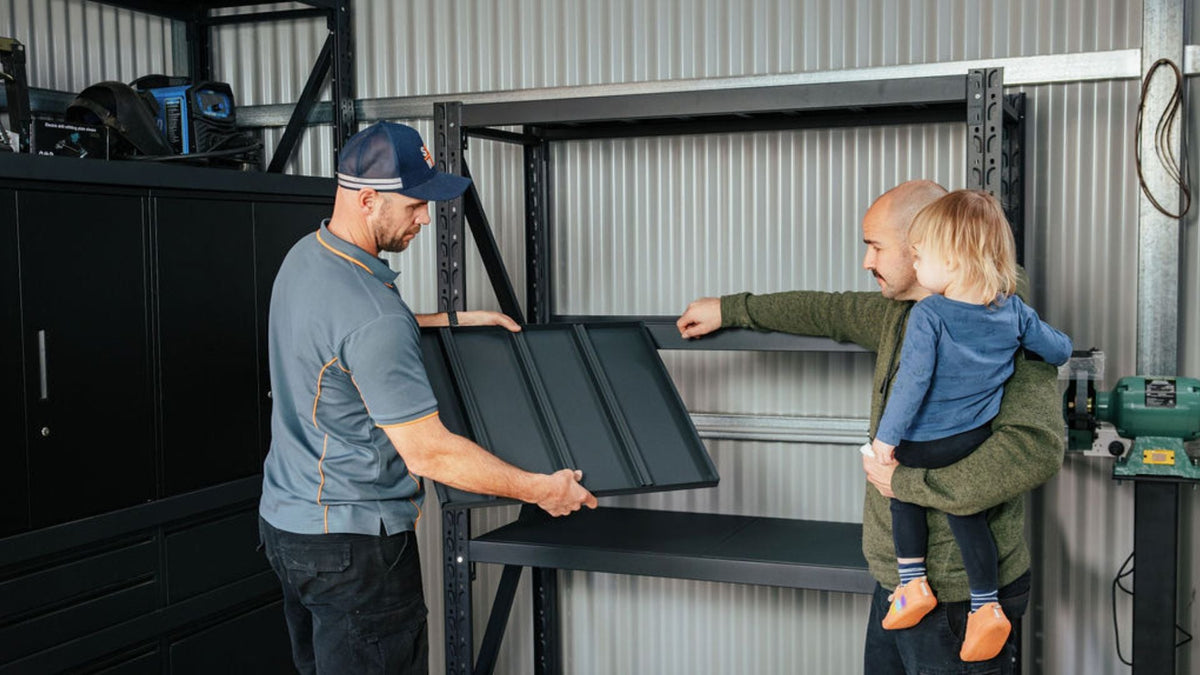
Here's where the "affordable without sacrificing capacity" tension actually gets resolved. Steel shelving units rated at 300, 500 kg per shelf don't just hold more, they hold everything without bowing, warping, or quietly giving way at 3am. That's the failure mode of cheap particleboard shelving: it handles the load fine until it doesn't, and then it takes everything with it. The cost-per-year argument is straightforward as an illustration: a steel unit at $210, $350 that holds up for many years costs far less annually than a particleboard shelf at $80 that warps and needs replacing every couple of years, plus the bonus trauma of watching your tools hit the floor. Lifespan will vary depending on load and use, but the durability gap between steel and particleboard is well established.
DIY timber shelving using 2x4 framing and OSB sheeting runs under $60 AUD in materials and is a genuinely solid option for lighter loads. For a larger build, four 8-foot shelves can be constructed for around $150. Those options absolutely earn a place in a budget garage setup, as supplementary storage for seasonal bins, a basic workbench frame, or a simple overhead platform. For the main shelving run handling tools, equipment, or anything over 100 kg, purpose-built steel is the safer and smarter long-term call.
Where to find quality steel shelving without the big-box markup
Shelving and Storage NE is the local alternative to large national retailers for anyone in the Albury-Wodonga region. Ben stocks steel shelving units from $210 (general use, 300 kg per shelf) to $350 (industrial use, 500 kg per shelf), backed by a 5-year warranty and a strong local reputation built shelf by shelf in a tight-knit regional community where word travels fast.
Same-day local delivery across Albury-Wodonga and surrounding areas is a genuine practical advantage. When you're ready to tackle the garage on a Saturday morning, waiting three to five business days for freight from an online-only national seller is genuinely annoying. Call Ben directly and arrange delivery on your timeline. The self-assembly design requires nothing beyond basic hand tools, no specialist knowledge, no frustrated YouTube rabbit holes.
Budget garage storage hacks: low-cost add-ons that stretch your storage further
Pegboards, bins and hooks: the cheap layer on top of shelving
Steel shelving handles the heavy lifting, but a well-organised garage also needs the small stuff sorted. A pegboard on one wall section keeps hand tools visible and reachable without consuming any shelf space, drills, spanners, screwdrivers, all of it on the wall where you can see it at a glance. Stackable plastic bins on shelves, labelled by category, create a system that everyone in the household can maintain without a briefing. Heavy-duty wall hooks are a low-cost alternative to many specialised mounting systems, managing bikes, hoses, and sports equipment without the premium price tag of purpose-built solutions. If you need specific ideas for pegboard layouts and accessories, local suppliers and pre-made kits can save time compared to building everything from scratch.
When DIY shelving makes financial sense
Be honest about where DIY genuinely wins. A basic 2x4 and OSB shelf unit under $60 is a strong option for lighter seasonal storage, and a fold-down workbench built from reclaimed or budget timber can be a cost-effective use of a corner that would otherwise go unused, materials cost will vary depending on what you source. DIY works best as a supplementary layer, not the main event. For heavy tools, equipment, or anything that will see real daily use, the time you'd spend building, adjusting, and eventually rebuilding a timber frame outweighs the cost difference versus steel. Use your DIY energy on the right jobs. For hands-on builders wanting simple, cheap shelf plans, the DIY garage shelves plans are a helpful starting point.
Your weekend action plan and shopping checklist
The declutter-first rule (it's not optional)
The single most common mistake in garage organisation is buying storage before deciding what to keep. Spend an hour sorting into three piles: keep, donate, bin. That's it. This step determines how much shelving you actually need, which zones need the most capacity, and whether you're about to spend money storing things you genuinely don't want anymore. Skip this step and you're likely to reorganise the wrong things, run out of space again sooner than expected, and be back where you started before long. For a seasonal-focused declutter and local tips, see the Spring Garage Clean-Out Tips for Albury-Wodonga Homeowners.
A simple checklist to implement this weekend
Here's the sequence that actually works, done in order:
- Measure your walls and sketch your four zones (car, active use, seasonal, workshop)
- Use the Shelving and Storage NE planning tool to photograph your space and validate your layout
- Order or pick up your steel shelving units, plus any hooks, bins, or pegboard sections needed
- Declutter the space completely before any shelving goes in
- Assemble shelving and anchor wall fixtures to studs or masonry
- Load items into their zones and label every bin
Done right, most garages can be substantially improved in a single weekend. A space that's been ignored for years can become functional and genuinely usable, often by Sunday afternoon, depending on size and how much decluttering is needed.
Get started this weekend
The question of how to organise your garage affordably without sacrificing storage capacity is really a planning problem, not a spending problem. The vertical space is already there. The budget is workable. The tools exist. What's been missing is the system, and now you have it.
Steel shelving is the preferred backbone of any serious garage setup, thanks to its higher load ratings and durability compared to cheaper alternatives. Everything else, hooks, bins, pegboards, DIY additions, builds on top of that foundation. Get the foundation right and the rest of the system clicks into place.
If you're in the Albury-Wodonga region and ready to move from planning to action, start with the layout planning tool at Shelving and Storage NE. Map your space, get a visual recommendation, and have your shelving units on the way the same day. Ben's number is right there on the site. The garage isn't going to organise itself, but this weekend, it absolutely can. For inspiration on how homeowners are transforming garages into usable rooms, read How Aussie Homeowners Are Turning Their Garage Into the Best Room in the House.
0 comments