

You know the drill. You walk into your garage on a Sunday morning with one simple mission: find the drill. Twenty minutes later, you've moved three boxes, rediscovered a cricket bat from 2019, nearly knocked a tin of paint onto the concrete, and the drill is still missing. The car hasn't fitted inside since the kids were born. And somehow, despite owning less stuff than ever, there's more chaos than ever. The right garage shelves are the fix, but picking the wrong ones means you're back to square one within three to five years, watching a warped timber shelf sag under the weight of your toolboxes, or a plastic unit buckle in the middle of an Albury summer.
This guide compares every major garage shelving type available in Australia right now: steel, wire, wood, and plastic. We're talking real load ratings, actual costs, how each material holds up in Australian conditions, and what installation actually involves. By the end, you'll know exactly which garage shelves suit your space and your budget. No spreadsheets required, no guesswork, no wasted weekend purchases.
The four types of garage shelves you'll find in Australia
Steel shelving: the outright workhorse
Steel dominates the serious end of the Australian garage shelving market for one reason: it handles everything you throw at it. Powder-coated steel frames deliver load ratings commonly sitting between 200 and 500 kg per shelf, they don't warp in the heat, and they laugh at chemical spills. Maintenance is minimal, that said, it's worth inspecting the coating periodically and touching up any chips or scratches before moisture gets a foothold. If you're storing power tools, car parts, paint tins, or anything that actually weighs something, steel is where the conversation ends.
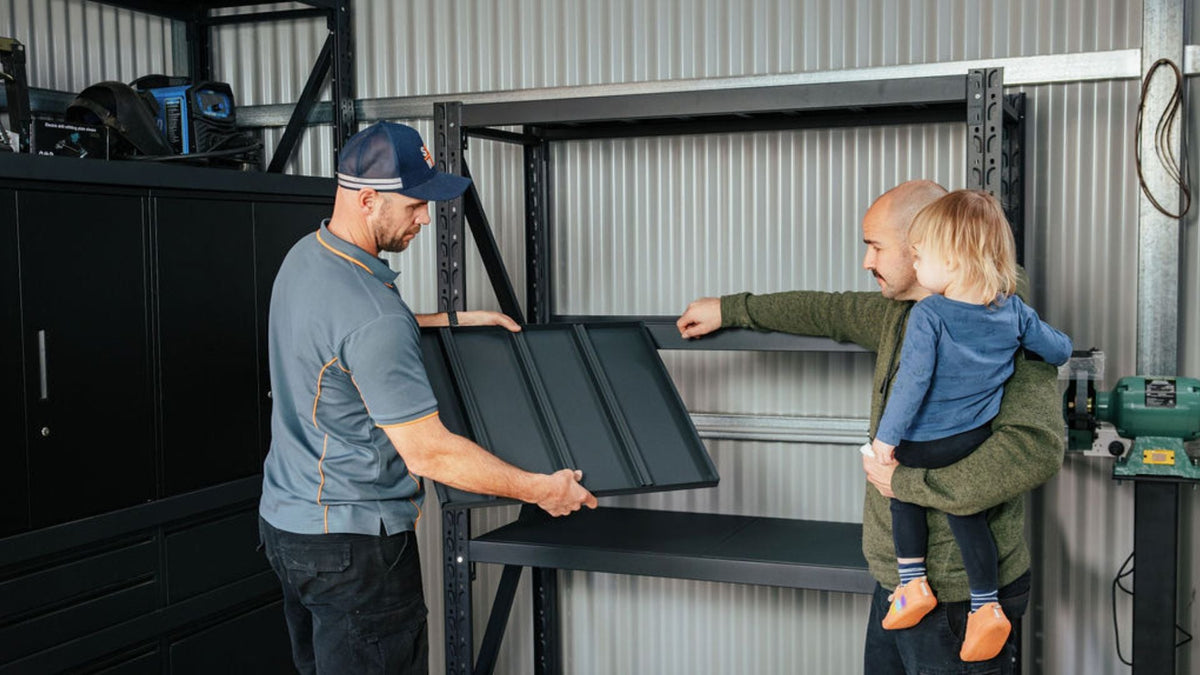
The two main configurations you'll encounter are general-use units, suited for most home garages, and industrial-grade units built for workshops and trades. General-use steel shelving typically handles 300 kg per shelf; industrial units push that to 500 kg or beyond. Both configurations are bolt-together systems designed for self-assembly, which means no tradesperson and no drama. Shelving and Storage NE in Albury-Wodonga has built its entire range around this category because it's simply what performs in real garage conditions.
Wire, wood, and plastic: where each one actually fits
Wire shelving earns its place in lighter storage situations. Capacities typically sit around 100 to 150 kg per shelf, and the open-wire design allows airflow, which makes it useful for laundry rooms, sports equipment, or seasonal gear that needs ventilation. The catch in a humid Australian garage is coating integrity: once a wire shelf's protective finish chips or scratches, moisture gets in and rust spreads fast underneath. Stick to wire shelving with an epoxy or heavy-gauge powder coat finish if you're putting it anywhere near a garage environment.
Timber is the classic DIY option and it absolutely has a role, particularly when you're building to a non-standard dimension or matching an existing aesthetic. The problem is moisture. Australian garages are harsh, and untreated timber absorbs humidity, expands and contracts through the seasons, and eventually warps or sags under sustained load. Plastic and resin units sit at the bottom of the capacity hierarchy at around 25 to 50 kg per shelf, making them fine for seasonal decorations and gardening gloves, but a liability for anything mechanical or heavy. Each material has a legitimate use case; the mistake is applying the wrong one to the wrong job.
Garage shelves load capacity: how much weight can each type actually hold?
What shelf load ratings really mean
The load rating printed on a shelf is a distributed load figure, meaning it assumes the weight is spread evenly across the full shelf surface. A shelf rated at 200 kg handles 200 kg of evenly spread boxes beautifully. That same shelf with a 100 kg engine block sitting in one corner is a different story entirely. Point loading concentrates stress at a single spot and can exceed the shelf's structural capacity well before you reach the rated figure. Always factor in how your heaviest items will actually sit on the shelf, not just how much they weigh.
In the Australian market, garage shelving broadly falls into three tiers: light-duty at 50 to 150 kg per shelf, standard-duty at 150 to 300 kg, and heavy-duty or longspan configurations at 300 to 500 kg and beyond. For anyone storing power tools, car parts, paint, bulk supplies, or workshop equipment, anything below 200 kg per shelf is a genuine risk. As a conservative rule of thumb: identify your heaviest likely load, then buy to double that capacity. You won't regret the headroom. For industrial applications and best practice on steel racking, it's worth consulting recognised standards such as the ANSI MH16.1 guidance on industrial steel storage racks (industrial steel storage rack standard).
Where each material lands on the capacity scale
Steel longspan shelving sits at the top of the hierarchy, with heavy-duty configurations routinely rated at 300 to 500 kg per shelf and some industrial units reaching total unit capacities above 800 kg. Wire shelving trails significantly at 100 to 150 kg per shelf in most Australian product ranges. Timber varies enormously depending on construction quality, span length, and whether the builder knew what they were doing with a level.
The practical takeaway is this: if your garage contains anything that belongs in the "heavy" category, the decision tree terminates at steel. Everything else is a compromise on load performance, and in a garage where heavy items get moved, bumped, and stacked, that compromise has a cost.
Durability of garage shelves in Australia: which material actually lasts?
What the Australian climate does to your shelving
Australian garages are genuinely brutal environments. Summer temperatures push past 40°C in many inland regions, humidity swings dramatically between seasons, and dust plus chemical spills are part of daily life. Timber absorbs that moisture and eventually warps or sags under sustained load, particularly when heat cycles dry it out and humidity cycles swell it again. Plastic becomes brittle and discoloured with UV exposure and heat cycling; structural integrity declines progressively over years of temperature swings rather than failing suddenly at any one point.
Wire shelving performs adequately with an intact protective coating, but once that coating chips, rust spreads underneath and compromises the structural frame. Among common shelving materials, powder-coated steel handles heat, humidity, dust, and chemical exposure with the least ongoing intervention required. The polymer coating blocks moisture from reaching the steel substrate, and as long as the finish stays intact and any chips are touched up promptly, corrosion risk stays low. For an Australian garage, that low-maintenance resilience is the critical differentiator.
Expected service life by material type
DIY timber shelves in an unconditioned garage typically need reinforcement or replacement within three to five years, especially under heavier loads in regions with pronounced seasonal temperature swings. Plastic units perform similarly under regular use, with degradation accelerating significantly under heat and UV exposure. Commercial steel shelving, assembled correctly and not overloaded, often lasts a decade or more with minimal maintenance, provided coatings are kept intact. When you factor in the cost of replacing timber or plastic shelving every few years, the higher purchase price of quality steel shelving starts to look like a bargain, not a premium price tag. For more detail on why many shelving systems fail quickly, read Why 90% of Garage Shelves Fail Within 3 Years (And What to Look For).
Real cost breakdown: what you'll actually spend
Price ranges across material types in Australia
Plastic shelving units start from as little as $25 to $30 at flat-pack retailers, though larger units with a meaningful load rating can run from $100 to well over $150 depending on brand, size, and capacity. Wire shelving typically sits in the $80 to $250 range for common sizes. Ready-made steel shelving runs from $150 to $350 depending on load rating and configuration, with premium industrial units reaching $350 to $500 or more. Timber cost depends entirely on whether you're buying a commercial unit or sourcing materials for a DIY build, and that distinction matters enormously.
When comparing shelving options at a local supplier like Shelving and Storage NE, it's worth asking for current pricing and warranty details directly, steel shelving in the general-use and industrial-grade ranges typically offers strong value on a cost-per-year basis compared to plastic or timber alternatives, particularly when you factor in longevity and load performance.
The hidden cost of DIY timber shelving
This is the section that genuinely surprises most people. A DIY two-car-garage shelving build in Australia can cost $600 to $1,100 once you factor in lumber, sheet materials, structural hardware, tool hire or purchase, and the wasted materials that come from measuring errors and first-time builder learning curves. A quality steel shelving unit in the $210 to $350 range looks like a premium on the product page. Against an $800 DIY build that needs reinforcement in four years, it's often the cheaper option over any medium-term horizon. If you're researching DIY approaches before committing, this DIY garage shelves resource provides common build variations and cost considerations.
DIY timber shelving is also not a quick Saturday job for most people. A basic garage build from scratch runs a full weekend, often longer, and still frequently requires adjustments after the first load goes on. If your time has any value at all, that calculation deserves honest consideration before you head to the hardware store.
Assembly and installation: what to expect before you commit
Freestanding versus wall-mounted garage shelves: the key trade-off
Freestanding units are the most practical choice for the majority of home garages. They're portable, require no wall anchoring in most configurations, and can be repositioned as your storage needs change over time. The trade-off is tip risk: tall, heavily loaded freestanding shelves should be anchored to the wall as a safety measure, even when the design doesn't strictly require it. If you have kids, pets, or anyone who might back into a loaded shelf unit, anchor it regardless.
Wall-mounted garage shelves maximise floor space and distribute load directly into the wall structure, making them a strong choice for smaller garages where every square metre counts. The installation requirement is stud anchoring: for any wall-mounted system carrying meaningful weight, fasteners need to go into structural studs rather than plasterboard alone. Find studs, use the correct screws, keep heavy items on the lower shelves, and check level before you start loading. It's manageable without a tradie if you follow those basics.
Tools, anchoring, and a realistic time estimate
The tools you'll need for most garage shelving installations are a stud finder, a drill, a level, a tape measure, and a screwdriver. That covers both unit types, freestanding and wall-mounted. Many bolt-together steel shelving units can be assembled by one person in under a couple of hours, and well-engineered designs generally mean you don't need a second pair of hands or a tradesperson to get it done.
Contrast that with a DIY timber build, which can occupy a full weekend and still require adjustments after the first load settles. The assembly experience is one of the clearest practical advantages of a well-engineered commercial steel unit over a site-built alternative.
How to choose garage shelves without second-guessing yourself
Matching shelf type to what you actually store
Here's the decision framework, and it's simpler than most buying guides make it look. If you're storing light household overflow, seasonal decorations, sports bags, or gardening supplies, then wire or plastic shelving is adequate and affordable. If you're storing tools, car equipment, paint, bulk supplies, or anything that weighs more than you'd comfortably carry, steel is the only material worth considering. If the garage doubles as a workshop, industrial-rated steel shelving and a solid workbench are non-negotiable from day one.
The rule that saves most people from a bad purchase: identify your single heaviest item or storage scenario, assume you'll eventually fill every shelf to near capacity, and buy to twice the load rating you think you currently need. Storage needs grow. Shelving flexibility doesn't. For a practical primer on why the differences matter in real installs, see Not All Garage Shelving Is the Same, Here's What Actually Matters.
Why a local supplier like Shelving and Storage NE removes the guesswork
Picking the right shelf type is one challenge. Working out whether it actually fits your specific garage layout, accounts for the door swing, works around the hot water system, and leaves enough aisle space to access everything, is a different problem entirely. Shelving and Storage NE, based in Albury-Wodonga, offers a free AI garage design tool that lets you upload a photo of your actual space and receive a personalised shelving layout with a visual render before you commit to a purchase.
Their steel shelving units are built to handle serious loads, and the team can talk you through warranty and delivery options directly. That combination of local knowledge, technology-forward planning, and genuine after-sales accountability is something a national big-box retailer rarely replicates. When you deal with someone who knows the region and the product, the process is a lot simpler from start to finish. Read more about How Aussie Homeowners Are Turning Their Garage Into the Best Room in the House to see real examples from the local area.
The bottom line on garage shelves in 2026
For most Australian garages, steel garage shelves deliver the best return across load capacity, durability, and long-term cost. Wire shelving works for lighter storage when airflow matters. Timber can be customised but carries hidden costs and real climate risks in unconditioned garage environments. Plastic suits light household overflow and nothing heavier. The right shelving for your space depends on what you're storing, how heavy it is, and how long you want your solution to actually last before you're doing the whole thing again.
If you want to skip the measuring, the material comparison rabbit hole, and the second-guessing entirely, Shelving and Storage NE's free AI design tool does the planning work for you. Upload a photo of your garage, get a personalised layout and visual render, and know exactly what you're ordering before you spend a dollar. Get in touch with the team to find out about delivery options across Albury-Wodonga. Your garage could look completely different by this weekend, and that's a much better Sunday than the one spent looking for a drill. For further reading on making the right shelving choice and common transformation ideas local homeowners use, visit Why 90% of Garage Shelves Fail Within 3 Years (And What to Look For).
0 comments